

The holiday season is full of joy, celebrations, and cherished traditions. But it can be easy to...
This month, we sat down with Deb, founder of Don't Trash Dover, to learn how eight years of showing up with a bag and a grabber turned into a litter cleanup movement spanning five New Hampshire communities and counting.
Tell us about Don't Trash Dover and how it got started.
I've been picking up litter my whole life. In 2018, my family and I moved back to downtown Dover, and I noticed things had really changed. There was a lot more litter than I remembered, and it was distressing because I loved being able to walk everywhere. So I just started carrying a bag and a pair of gloves on my walks and picking things up. When I got home, I'd separate the recycling and toss the trash. Nothing fancy.
People would drive by and roll down their windows and yell things at me and it would scare me half to death before I realized they were yelling nice things and thanking me. I thought, “that's a funny reaction, because I'm not doing anything special. You can do it too.”
Eventually someone asked if they could come with me. I said sure, and offered to go out once a month, for one hour, and said whoever wants to come can come. For the longest time it was just my husband, my son, and me. I started a Facebook group and there were three people in it. I was related to all of them. But gradually, people started showing up. Now it's been over eight years of year-round monthly cleanups, and we've grown to five communities: Dover, Barrington, Somersworth, Rochester, and Milton.
What makes Don't Trash Dover different from other cleanup groups?
I don't have zones. I don't tell people where to go. I tell them to go in whatever direction they want, bring a buddy, and come back five to ten minutes before we're done. Walk fast and you'll cover more ground, walk slow and you won't, but you'll find trash either way. And don't worry if you walk behind someone or backtrack your own path, because everyone misses things.
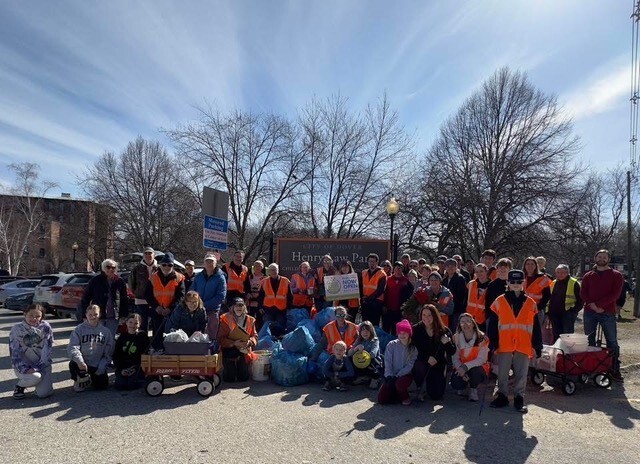
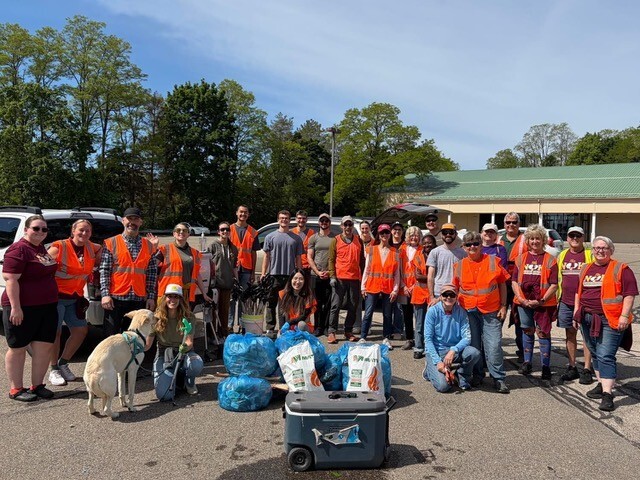
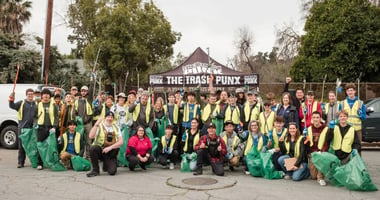
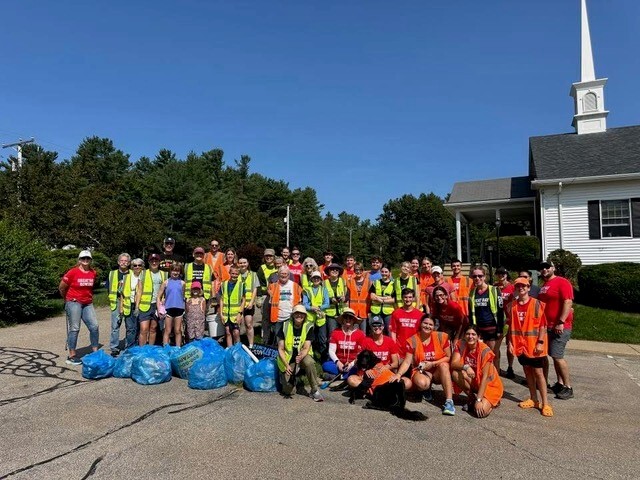
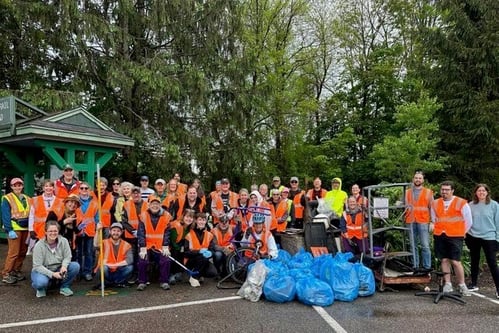
I also run a very tight ship on time. I start on time, I end on time, and I respect that people are giving me an hour of their day. I never want it to feel like an obligation or a chore. I want people to leave feeling pumped. And the group photo at the end is a big part of that. I always ask people to hold up the weirdest things they found. A concrete garden edging brick, a broken shovel, one of those decorative cigarette snuffer posts. It makes people laugh and it's a great record of what we accomplished together.
 Right after every event, I post to our Facebook group with that photo, the number of volunteers, the number of bags collected, and always the phrase "in just 60 minutes." That's intentional. The whole concept is built around the power of an hour. It's a reasonable ask and almost anyone can give 60 minutes. When people see those posts and realize what a small group of neighbors can do in one hour, it's pretty motivating.
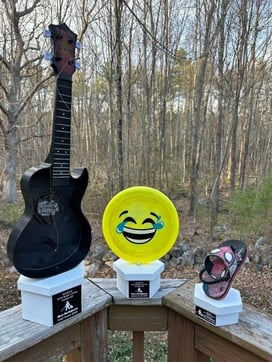
Every April in Dover, we scale that idea up into what we call Power of an Hour, our ‘Super Bowl’. Instead of one departure location, we have six. This past April, 362 volunteers fanned out across the entire city and picked up nearly two tons of trash in one hour. We give out trash trophies at the end, made from actual litter collected throughout the year, to the three wards with the most participants. Because having the most trash in your ward is not something to be proud of, but showing up to clean it is.
You've mentioned going out no matter what. How serious are you about that?
In eight years I have never missed a single event. We go out in snow flurries. We go out in rain. The rule is if we can see the litter, we go. Torrential downpour is just about the only thing that stops us, and I can count those cancellations on one hand.
I'll be honest with you, we lost our dog at the end of February this year and it was a really hard week. She had been in the hospital since Tuesday, and I had Don't Trash Dover that Saturday. I asked a close friend who's been volunteering for years if she could lead it in case I couldn't be there. It turned out I was able to go. When I pulled in, I stayed in my car so she could have that moment leading the group. And when everyone came back she looked at me and said, "I thought you weren't coming." I said, "I've never missed one in eight years. I wasn't going to start now."
How do you attract and keep volunteers coming back?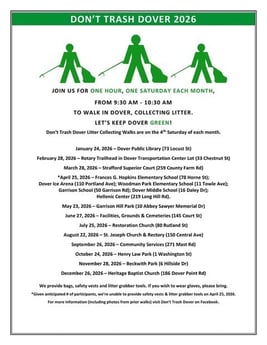
I think it needs to be fun. That's the core of it. People come, they get some exercise, they meet good people, and they can actually see what they did. You filled that bag. You did something real. That tangibility matters.
I also keep it low-pressure. Our Facebook group has the schedule for the entire year posted and pinned, so volunteers know when and where each event is going to happen. I've had events where 48 people show up when only three people marked themselves as "going" on Facebook. I take RSVPs with a grain of salt. My philosophy has always been: “I'm going anyway. If you want to come with me, great.” I don't chase anyone and I don't want it to feel like an obligation.
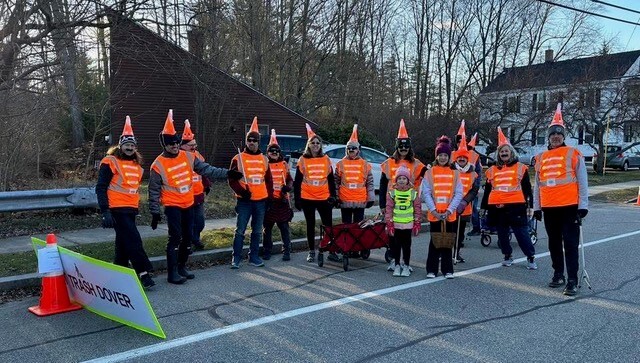
Our volunteers range from little kids to people in their 80s. I think that's a point of pride. It's come as you are, do what you can.
How do you handle supplies and fundraising?
My husband and I self-funded in the beginning. As we grew, we bought more grabbers, then someone sent a check for $200 and we bought more. After about five years of showing up consistently, I went to the city and made the case that we were saving them real money on litter control, and they agreed to start funding safety vests and grabber tools. It took demonstrating a long track record, but it happened.
The community has stepped up in ways I never expected. Some of the sweetest moments have been the smallest ones. A group of volunteers ran a lemonade stand and donated the money to buy tools and vests. A regular volunteer who was too ill to participate insisted on sending a donation instead. A local store donated tools when they heard about what we were doing. A local business owner has donated money several times. And one year, a school held a penny drive and donated the funds to us as a thank-you for the annual cleanup we do on their grounds. ArcMate has also donated litter grabbers to support the group, which has meant a lot.
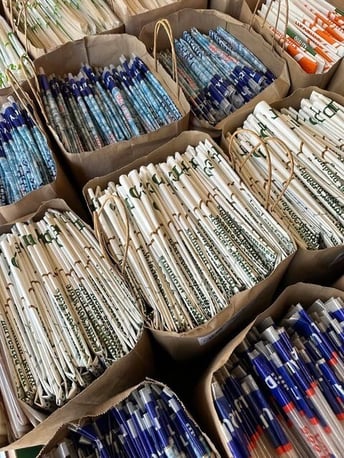
For bags, we're fortunate in New Hampshire to have a program called New Hampshire the Beautiful, run by the Associated Grocers Association and Coca-Cola, which provides bags at no cost to volunteers collecting public litter.
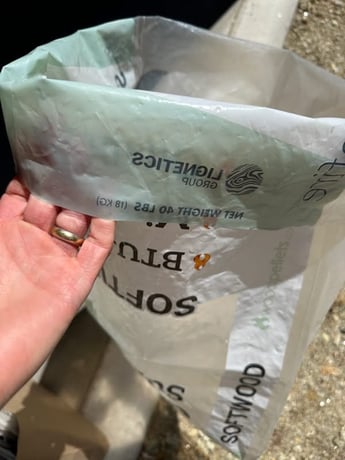
The bags I actually use day to day are pellet bags, not the provided blue bags. The blue bags are flimsy and huge, and on a windy day near roadside brush they shred. Pellet bags hold about 40 pounds, are made of a durable plastic, and you can cuff the top over to give yourself a better grip. I've been washing and reusing the same ones for eight years. I bring them home, hose them out and hang them to dry.
Tell us about your aluminum can recycling initiative.
About a year ago, I started asking volunteers who were willing to, to separate aluminum cans from the rest of their litter. I never made it mandatory. One person in each pair carries the bag with the aluminum cans, the other carries everything else. It's simple.
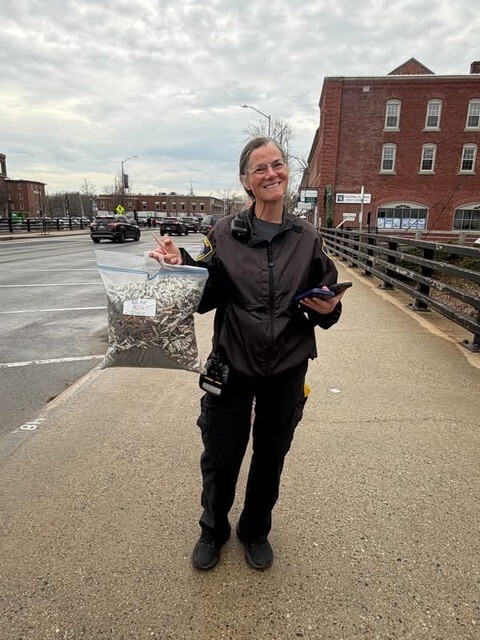
 At our big annual April event, which runs six locations citywide for one hour, we diverted 80 pounds of aluminum cans from the landfill in a single morning. I take them to a scrap metal facility a couple miles from my house. That 80 pounds paid me $60. That's $60 that goes right back into buying equipment.
Aluminum is fairly valuable and highly recyclable, and so much of what we find is beer cans and spiked seltzer cans. It feels wrong not to do something with them. Plastics are a different story, so we only separate the aluminum and let everything else go to trash. I can't do it all, but this I can do.
Are there any types of litter you're grappling with right now?
Vapes are a big challenge. Disposable vapes contain lithium-ion batteries, which makes them household hazardous waste. In our community, hazardous waste day is once a year, so I collect them in a five-gallon bucket with sand in it and hold on to them until I can dispose of them properly. Legislation is slow to catch up on how communities should be handling these, and I think it's going to be a growing problem before it gets better.
I also use those events as a teaching moment. A lot of my volunteers have no idea what they're looking at when they find one. I'll hold up a disposable and a rechargeable and show them the difference, and ask people to set them aside rather than tossing them in the bag with everything else.
Do you work with schools and businesses?
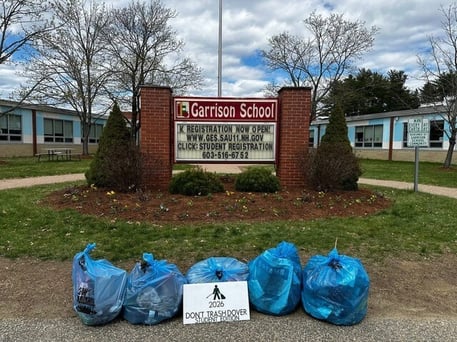
Yes, in addition to our monthly events! Every April I visit elementary schools to do a cleanup on their school grounds with the kids. They love the tools. I always have to remind them that grabbers are not swords or lightsabers and need to stay on the ground. But they get so excited about it and I think that energy matters. Kids are passionate about the earth in a way that a lot of adults have forgotten.
We also work with local businesses and organizations that want to do cleanups as a group. And we've taken on something that I'm particularly proud of, which is refurbishing cigarette butt receptacles downtown. Each one has a Don't Trash Dover volunteer assigned to empty it, and we send the cigarette butts to an organization called Breathe NH for recycling. It's a small thing, but it keeps a lot of material out of the environment and off the sidewalks.
How can people support your mission?
Less of a "what can you do for Don't Trash Dover" and more of a mindset shift. One of my group leaders posted on social media that her mom goes out on a pontoon boat and picks up litter on the lake. Her son says "Don't Trash the Gym" when he walks into one. That's what I want to see more of. Don't Trash anywhere. Don't litter. And if you didn't drop it, pick it up anyway, because saying "I didn't drop that" while you walk past it means you're part of the problem.
And if you want to start a group in your community, just do it. It doesn't take much. A bag, a pair of gloves, and a willingness to show up on a regular schedule. That's how this whole thing started.
To learn more about Don't Trash Dover or find a cleanup near you, you can find them on Facebook.